
COMPLETED
Last Updated:
3. TÜBİTAK 1004 (SÜİT)
Next-generation smart and integrated observation systems for effective management of water ecosystems
Period: 36 AY
Budget: 2,999,992,00 TL
Direction: Prof. Meryem Beklioğlu
Project Background: Aquatic ecosystems are deteriorating due to human-induced changes like urbanization and excessive nutrient loads, triggering eutrophication. Climate change worsens these effects, leading to harmful algal blooms (HAB) and biodiversity loss. Traditional approaches fail to manage these crises effectively. Algal groups causing HAB, with their higher optimum growth temperature range, show a significant increase due to global warming. HAB leads to toxin production, mucilage formation, and decreased oxygen levels, impacting aquatic life and human water use. This damages ecosystem services such as irrigation, drinking water, fisheries, and recreation.
Aquatic ecosystem changes, often non-linear, description through periodic or event-based monitoring programs. Emerging sensor systems, deploying isolated sensors, lack the breadth to understand their dynamics. To get these interactions, instant, autonomous systems are necessary, responding to various phenomena across large geographic and temporal scales. Intelligent, integrated observation systems are needed, including central stations and boundary nodes, capable of understanding and responding to complex interactions within water bodies and their surroundings.
The project aims to establish pilot observation areas at ODTÜ Ankara Campus Eymir Lake and ODTÜ Erdemli Campus to enhance ecosystem observation capabilities from local to THS 3-6 levels. It will develop communication and operation technologies for multi-node systems in aquatic ecosystems, understanding precursor signals before major disruptions. The main goal is to create an innovative ecosystem monitoring platform applicable in various aquatic ecosystems, advancing to THS 6 level. Targeted areas include efficient ecosystem management, water quality control, adaptation to climate change, and prediction of harmful algal bloom increases.
• Efficient ecosystem and protected area management
• Lake water quality management
• Eutrophication and mucilage control in seas and inland waters
• Preservation of drinking water quality
• Maintenance of coastal tourism areas in good condition
• Adaptation to climate change
• Urban landscape and natural resource management
• Prediction of harmful algal bloom increase
For more detailed information, please visit https://cng-eee.metu.edu.tr/suit-platform/
2. TUBITAK 1001 (119Y265): Resistance, Resilence and Recovery of Microbial and Plankton Community to Climate-induced re-current pulse tDOC disturbance in freshwater lakes: mesocosms study (Acronym: R3-DOC)
Funded by: TUBITAK, budget: 746,712.00 TL
Direction: Prof. Dr. Meryem Beklioğlu (PI), Assist. Prof. Dr. Emmanuel (Manolis) LADOUKAKIS (Researcher), Assoc. Prof. Dr. Efe Sezgin (Researcher)
Project Background:
Global climate change threatens freshwater ecosystems structures and function through dramatic loss in diversity (Woolway and Merchant 2019). Multiple climate models predict major changes in precipitation patterns (Knutti and Sedláček, 2013) with enhanced net precipitation with flush floods in the North temperate zone (IPCC, 2014) and Mediterranean climate regions (Polade et al. 2017) that has current implications in Turkey (Oktay Akkoyunlu, Baltaci, and Tayanc 2019). Such variations in precipitation regimes will expose aquatic communities to increased transport of materials in various forms including dissolved, particulate organic and inorganic matters from terrestrial ecosystems through catchment runoff (IPCC, 2007; HELCOM, 2007) especially to terrestrial dissolved organic carbon (tDOC), which is known to have a profound control on lake ecosystem structure and function (Robidoux et. al 2015; Seekell et al. 2015). Higher load of tDOC to aquatic ecosystems causes increased turbidity as well nutrient availability that may alter composition and biomass of primary producers, microbial production, shifts in metabolic rates, biogeochemical processes, and foodweb dynamics (Degerman et al. 2018).
Objective:
Through proposed mesocosms experiment, we will be able to test response of communities in terms of resistance, resilience and recovery. We will test resistance (insensitivity to disturbance) and the recovery of the communities by comparing the community structure before and after the disturbance. Also, we will test resilience (the rate of recovery) using a series of samples after two consecutive disturbances. Finally, we will test for functional redundancy of the communities.
Hypothesis:
We expect that, the more resistant and resilient a system is, the faster it will recover after the disturbance and the more similar will be with the initial system. Also, the more redundant a system is, the functional diversity will remain similar but the taxonomic structure of the communities will change.
Methodology:
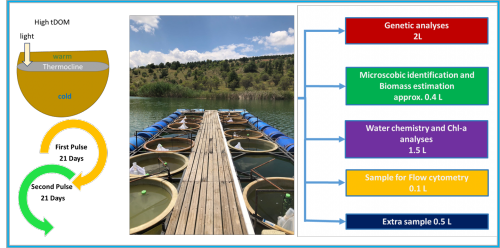
To test how does the freshwater community responds to DOC disturbance as a result of flush-floods received in Mediterrenean regions, we will use a METU Mesocosm System as a controlled experimental setup. Proposed mesocosm system will follow factorial design (2 treatment x 4 replicates) with 4 replicates of control, local tDOC and highly standardized Humid-feed DOC. To simulate flush-floods, DOC will be added in re-current pulsed manner to treatment tanks in the 2nd and 6th weeks of the 9 week- lasting experiment. We will investigate changes in system dynamics before and after the first and second pulse disturbance-in terms of response, recovery and resilience through the changes in species and functional traits diversity, and species and community abundances and biomass. Microbial and plankton communities including bacteria, HNF, ciliates, phytoplankton and zooplankton species will be investigated from daily to weekly sampling time frames. For the further detailed investigation of the changes in plankton and microbial community structure, Next Generation Sequencing (NGS) Illumina amplicon sequencing of 16SRNA and 18SRNA will be performed along with the biomass estimations for which microscopic identification of organisms will be undertaken.
1. TUBITAK 2232 (118C250): "Climate change effects on trophic structure and dynamics in saline and brackish water based on a space-for-time field sampling, controlled mesocosm experiments, paleoecology, remote sensing and modelling (CLIM-SALTLAKES)"
Funded by: TUBITAK, budget: 3,700,612 TL
Direction: Prof. Dr. Erik Jeppesen (PI), Prof. Dr. Meryem Beklioğlu, Prof. Dr. Zuhal Akyürek, Asst. Prof. Dr. Korhan Özkan
You can find the web site of project here.
Project Background
Global temperature and precipitation patterns have already been changing as a result of climate change, and the change in the semi-arid and Mediterranean climate zones are predicted to be particularly dramatic. A 25-30% decrease in precipitation and a parallel increase in evaporation in the Mediterranean region are expected by the end of the 21st century. Moreover, the land in drought is expected to double from 2000 to 2100. The magnitude of these changes and a consequent increase in salinity poses a major threat to the functioning and biodiversity of lakes. Novel studies that we have performed in North West China have shown drastic reductions in biodiversity (taxon richness), food chain length and average trophic position in the pelagial of the lakes with increased salinity. This indicates a loss of lake ecosystem functioning, and regime shifts when specific salinity thresholds are reached. However, the knowledge on the effect of warming on saline lakes is fragmented and far from at the level achieved for freshwater lakes.
Objectives
In this project, we aim at providing novel understanding of the structure and functioning of different types of saline/brackish lake ecosystems and their response to key stressors (warming, abstraction and external nutrient loading).
Hypothesis
We hypothesize that global warming and global change will
1) enhance the proportion of lakes that are saline,
2) enhance the variability in salinity,
3) make saline lakes more sensitive to other stressors such as excess nutrients and species invasions,
4) substantial decrease in species and trait richness of the organisms, and
5) consequently lead to major reduction in ecosystem functions and services.
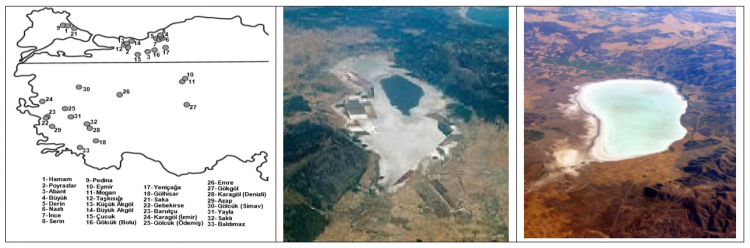
Fig.1: Left: Freshwater lakes sampled in Turkey by METU. Mid and right two saline lakes (Acıgöl and Palas Tuzla) subjected to strong additional salinization due to water abstraction and climate warming.
Methodology
To test these hypotheses, we will use a multi-faceted approach, including
1) field observations through space for time substitute with snapshot samplings in different climate zones (in the short term, Turkey and Central Kazakhstan, in the long-term, inland saline lakes from Brazil to Tibet and a north-south gradient from Denmark to Turkey sampling)
2) analyses of changes in the past century by palaeoecological studies of sediment archives,
3) and on a decadal scale by analyzing existing contemporary time series and use of remote sensing,
4) establish highly equipped advanced mesocosm experimental facilities at Ankara and Mersin METU campus and run a series controlled mesocosms experiments, and
5) finally, by conducting modelling for prediction and syntheses.
We expect that METU within the three years project period will achieve an international leading role in the ecology of saline lakes in a climate change perspective, and using this platform and by attracting scientist to do or join studies in the new advanced experimental facilities, we expect that METU will become a true world leader in this field over the next 10 years period.